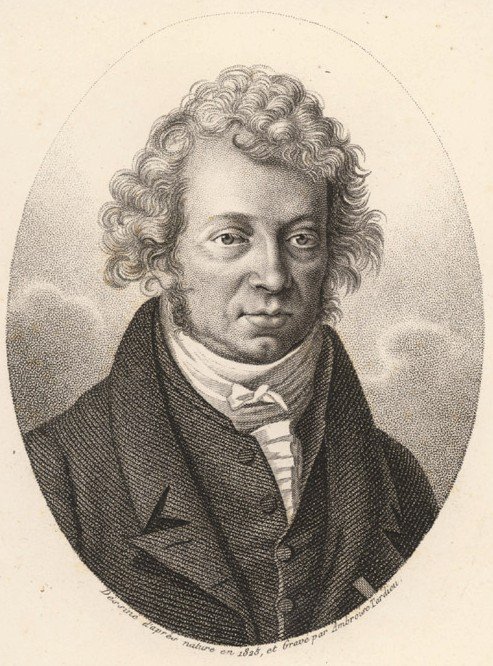
André Marie Ampère
André-Marie Ampère was a French physicist and mathematician who was one of the founders of the science of classical electromagnetism, which he referred to as “electrodynamics”. He is also the inventor of numerous applications, such as the solenoid and the electrical telegraph.
Background<<
He was born January 20 1775 at Lyon, France.
Ampère, who was born into a prosperous bourgeois family during the height of the French Enlightenment, personified the scientific culture of his day. His father, Jean-Jacques Ampère, was a successful merchant while his mother was a devout woman, so Ampère was also initiated into the Catholic faith along with Enlightenment science.
He spent his childhood and adolescence at the family property at Poleymieux-au-Mont-d’Or near Lyon. His father was Jean-Jacques Ampère, a businessman; his mother was Jeanne Antoinette Desutières-Sarcey, the orphaned daughter of a silk-merchant.
The education André-Marie received was rather unusual. His father was a great admirer of Jean-Jacques Rousseau, one of the leaders of the French Enlightenment. He decided to follow Rousseau’s approach for André-Marie’s education. This meant no formal lessons.
In 1802 Ampère was appointed a professor of physics and chemistry at the École Centrale in Bourg-en-Bresse.
After the death of his wife in July 1803, Ampère moved to Paris, where he assumed a tutoring post at the new École Polytechnique in 1804. Despite his lack of formal qualifications, Ampère was appointed a professor of mathematics at the school in 1809. In addition to holding positions at this school until 1828, in 1819 and 1820 Ampère offered courses in philosophy and astronomy, respectively, at the University of Paris, and in 1824 he was elected to the prestigious chair in experimental physics at the Collège de France.
At the age of 61, Ampère caught pneumonia. He died in the French Mediterranean city of Marseilles on June 10, 1836. He was buried in Marseilles, but his remains were later moved to the Montmartre Cemetery in Paris.
CONTRIBUTIONS<<
In September 1820, François Arago demonstrated Oersted’s electromagnetic effect to France’s scientific elite at the French Academy in Paris. Ampère was present, having been elected to the Academy in 1814.
Ampère was fascinated by Oersted’s discovery and decided he would try to understand why electric current produced a magnetic effect.
Ampère began by repeating Oersted’s work, and before the end of September 1820, had made a discovery of his own: he found that if electric current flows in the same direction in two nearby parallel wires, the wires attract one another; if electric currents flow in opposite directions the wires repel one another.
Ampère had discovered something amazing: he had produced magnetic attraction and repulsion in the complete absence of any magnets. All of the magnetism was generated electrically. He called this new field electrodynamics.
Ampère then brilliantly found an equation connecting the size of a magnetic field to the electric current that produces it. This equation, known as Ampère’s circuital law, is highly mathematical, requiring university level mathematics to use and understand. It is shown below in differential form relating the magnetic field (B) to the current density (J).
Ampère also discovered and named the element fluorine. In 1810, he proposed that the compound we now call hydrogen fluoride consisted of hydrogen and a new element.
Ampère proposed that fluorine could be isolated by electrolysis, which Davy had previously used to discover elements such as sodium and potassium.
SIMILARITIES
Like Ampére, I was also interested studying Mathematics when I was younger. The last similarity between me and Ampére is that we are both devoted to the Church.
reference:https://www.famousscientists.org/andre-marie-ampere/

 Science Blog